
Plants
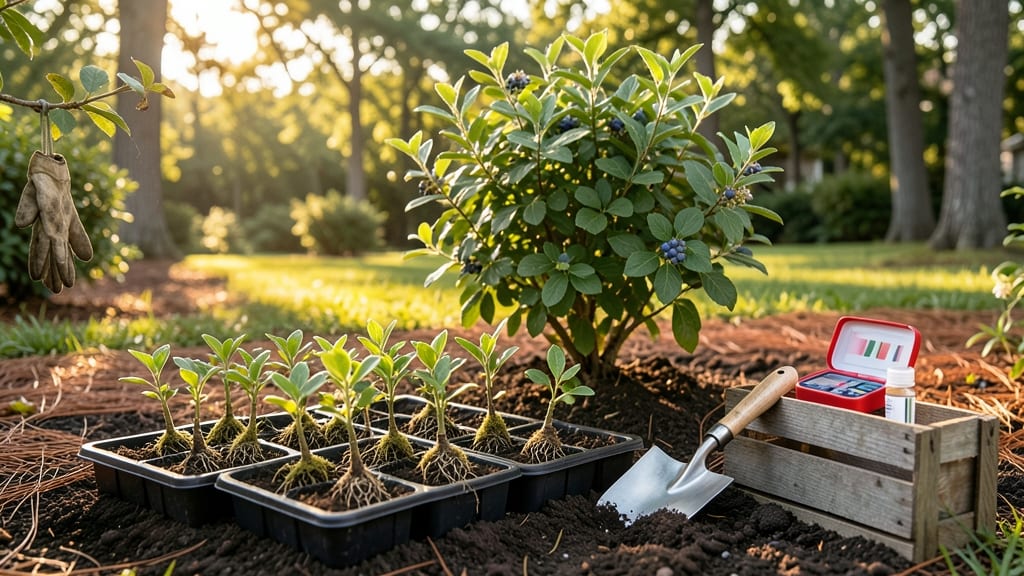
Timing your blueberry planting in South Carolina isn't just about the calendar—it's about matching your bushes to the chill hours your region actually delivers. Get it wrong, and you might end up with beautiful foliage but no fruit, or worse, a bush that struggles to survive the first winter.
Most gardeners in SC's 7b-9a zones know the basics—plant in fall or early spring—but what you might not realize is that September through October is the sweet spot for most varieties.
This window gives roots time to establish before winter dormancy kicks in, setting your bushes up for a bountiful harvest next summer.
I've helped countless South Carolina gardeners navigate these decisions, and the key is understanding how your specific chill-hour zone interacts with planting time. Whether you're working with bare-root plants or container-grown bushes, the right timing can mean the difference between a thriving 🫐 patch and years of frustration.
Let me walk you through exactly when to plant in each of SC's chill zones, which varieties thrive where, and how to prepare your soil for maximum success—so you can look forward to that first harvest of juicy, homegrown blueberries in June or July.
Best months to plant blueberries in SC by chill-hour zones
South Carolina’s climate varies dramatically from the mountains to the coastal plains, creating three distinct chill-hour zones that dictate when to plant blueberries.
The Upstate (Zone 7b) needs 600-800 chill hours, while the Midlands (Zone 8a) require 400-600 hours, and the Lowcountry (Zone 9a) thrives with 200-400 hours. Planting at the wrong time can delay fruit production by up to 2 years.
For optimal root establishment, aim to plant blueberries when soil temperatures are below 70°F but above freezing. In SC, this window opens in late winter (February-March) and closes in early spring (April). However, fall planting (September-October) is ideal for container-grown bushes, allowing roots to settle before winter dormancy.
Here’s how to match your chill-hour zone to the best planting months:
| Chill-Hour Zone | Best Planting Months | Soil Prep Tip | Transplanting Time |
|---|---|---|---|
| 600-800 hours (Upstate) | February–March or September–October | Add peat moss to lower pH to 4.5-5.5 | Before last frost (mid-March) |
| 400-600 hours (Midlands) | March–April or September | Mix in sulfur for acidity | After last frost (late March) |
| 200-400 hours (Lowcountry) | September–October only | Use container planting with acidic mix | Before first frost (mid-November) |
In the Upstate (Zone 7b), where winters are cooler, plant bare-root bushes in February to give roots time to harden before summer heat. For the Midlands (Zone 8a), March-April is ideal—wait until after the last frost to avoid root damage.
Meanwhile, the Lowcountry (Zone 9a) only has one safe window: September-October, as summers are too hot for transplanting.
When planting, dig a hole twice as wide as the root ball but only as deep as the container. This prevents root suffocation while allowing room for growth.
Amend the soil with composted pine needles or sphagnum peat to maintain acidity. After planting, water deeply to eliminate air pockets and encourage root spread.
For container-grown blueberries, fall planting is best—place pots in a shaded area for the first 2 weeks to reduce transplant shock. Move them to full sun once new growth appears in spring.
Containers also work well in the Lowcountry, where soil pH is often too high for in-ground planting.
Timing isn’t just about months—it’s about chill hours. If you live in Zone 9a and plant a high-chill variety like ‘Climax,’ you’ll likely get no fruit because it needs 800+ hours of cold. Instead, choose southern varieties like ‘Misty’ or ‘Premier,’ which thrive with 300-500 hours.
Pro tip: Use a chill-hour calculator (like the one from Clemson University) to confirm your zone. Then, adjust your planting date 2-4 weeks earlier if your winter was unusually warm. Blueberries are perennial, so getting the timing right now means decades of harvests.
Once planted, mulch with pine straw to retain moisture and acidify the soil gradually. Avoid wood chips, which can raise pH over time. With the right timing and care, your blueberry bushes will reward you with sweet, juicy berries for years to come. 🫐
Best months to plant blueberries in SC by chill-hour zones
South Carolina’s three distinct chill-hour zones (400-600, 600-800, 800+ hours) dictate the best planting windows for blueberries. Chill hours are critical because they trigger flowering and fruit production. If you plant outside these windows, your bushes may fail to produce berries—or worse, die from winter stress.
For low-chill zones (400-600 hours), like Charleston or Hilton Head, aim for September to early November. These areas experience milder winters, so planting in fall allows roots to establish before the first frost.
In contrast, higher-chill zones (800+ hours), such as the Upstate, can plant as late as mid-November or even early December.
Spring planting is also viable but riskier. Plant between February and March, ensuring you finish before the last frost (typically mid-March). Spring-planted bushes need consistent watering to prevent drought stress during their first summer.
| Chill-Hour Zone | Best Planting Window | Soil Prep Tip | Transplanting Tip |
|---|---|---|---|
| 400-600 hours (Lowland SC) | September-October | Test pH (aim for 4.5-5.5) | Water deeply after planting |
| 600-800 hours (Midlands SC) | Late September-November | Add sulfur to lower pH | Mulch with pine straw |
| 800+ hours (Upstate SC) | October-Mid November | Mix in peat moss | Plant deeper than container level |
When planting in fall, focus on bare-root plants for best results. They establish roots more easily before winter dormancy. If you prefer container-grown bushes, plant them slightly deeper than their current soil line to encourage root expansion into the surrounding soil.
After planting, mulch heavily with pine straw or wood chips to insulate roots from temperature swings. In spring-planted bushes, avoid fertilizing until new growth appears (usually 4-6 weeks after planting). Over-fertilizing can burn tender roots.
Remember: Blueberries hate soggy soil. Ensure your planting site has well-draining soil and avoid low-lying areas where frost collects. In Zone 9 (e.g., Charleston), consider dwarf varieties like 'Peach Sorbet' to reduce winter stress risks.